Armenia’s election and the politics of Western approval - VIDEO


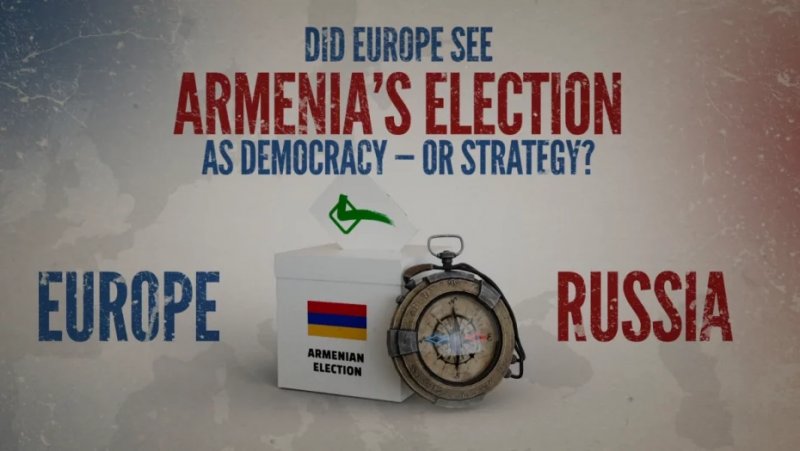
Armenia has every right to choose Europe. But Europe’s support for Armenia’s direction should not become automatic approval of its political process.
Armenia’s June 7 parliamentary election was not read in Europe as a routine domestic contest. It was read as a signal. When Nikol Pashinyan’s Civil Contract party secured 49.81% of the vote, and Strong Armenia came second with 23.29%, the result immediately carried meaning beyond the arithmetic of seats and parties.
The political direction was clear enough. Pashinyan has spent recent years moving Armenia away from Moscow’s orbit and towards closer ties with Europe and the United States. His opponents, especially Strong Armenia, were widely viewed as more sympathetic to Russia. That made the election not only a test of political support inside Armenia, but also a test of geopolitical direction in the South Caucasus.
This framing was not invented by commentators after the fact. The vote was repeatedly described in international media as a contest between Armenia’s European trajectory and Russia’s remaining influence. There was reason for that. Russia’s role in Armenia has not disappeared. It remains present through security history, economic links, energy dependence and the habits of post-Soviet politics. Even as Armenia looks west, Moscow still has tools of pressure and leverage.
That is precisely why the Western reaction matters. European leaders were quick to congratulate Armenia. The language was warm. The result was linked to democracy, peace, regional cooperation and closer ties with Europe. French President Emmanuel Macron also congratulated Pashinyan, reinforcing the sense that Armenia’s pro-European course had been politically welcomed.
There is nothing wrong with Europe supporting Armenia’s sovereign right to choose its own direction. Armenia has every right to deepen ties with Europe. Russia has no right to decide Armenia’s path. But there is a difference between supporting a country’s strategic orientation and treating that orientation as a substitute for scrutiny.
That is where the election becomes more complicated.
Civil Contract won clearly. The opposition did not come close to overtaking Pashinyan’s party. International observers said voters were offered a genuine choice and that the process was generally well run. These are important points, and they should not be dismissed.
But the vote was not free of controversy. Strong Armenia filed a petition seeking to annul the results, citing alleged irregularities. Armenia’s Central Election Commission invalidated results from two polling stations after a significant military presence was reported after polls had closed. That decision reportedly pushed Prosperous Armenia below the 4% threshold required to enter parliament.
The numbers are striking. Prosperous Armenia was reportedly around 3.996%. The threshold was 4%. The reported gap was about 0.004 percentage points, described as roughly 60 votes. That does not prove fraud. It does not invalidate the election. But it does complicate the image of a clean democratic victory.
There were other warning signs too. Reuters reported that six Strong Armenia candidates were arrested one day before the vote. The observer assessment was balanced: genuine choice, a generally well-run process, but also pressure, polarisation and concern around the wider political environment.
Europe, therefore, had two sets of facts in front of it. It had enough language to praise the election. It also had enough warning signs to be cautious. The praise came fast. The caution did not.
This is not only about Armenia. It is about the way Europe applies democratic language in contested political spaces. When an election delivers a result that aligns with Western strategic preferences, the language of democratic progress often arrives quickly. When an election produces a less convenient outcome, the vocabulary changes: legitimacy, crisis, backsliding, pressure, and investigation.
Georgia offers the obvious comparison. The cases are not identical, and they should not be treated as identical. But the contrast is hard to miss. In Georgia, election concerns rapidly became a crisis of legitimacy in the Western political conversation. In Armenia, concerns were folded into a broader story of democratic progress and European alignment. Same region. Different political temperature.
Western support did not need to look like direct interference to matter. Politics is also shaped by atmosphere, timing and signal. Before the vote, Yerevan hosted major European gatherings. During his visit to Armenia, Macron publicly backed Pashinyan’s pro-European course. None of this proves electoral manipulation. But it did make clear what kind of Armenian outcome Europe would welcome.
That is the central tension. Armenia’s westward turn may be strategically important. It may also be good for Armenia’s long-term sovereignty. But Europe’s support for Armenia’s direction should not become automatic approval of its political process.
Democracy is not only about who wins. It is about how power is won, how opposition is treated, how institutions behave under pressure and whether the same standards apply to friends and rivals.
The question is not whether Europe welcomed Pashinyan’s victory. Of course it did. The question is whether Europe looked closely enough after he won.
See the original article here
By Ulviyya Salmanli


Similar news